Showing posts with label edemocracy. Show all posts

Thursday, February 28, 2013

Update Liveblogging GovCamp NSW (focus on innovation)

I'm in Sydney at GovCamp NSW today, where the program is focusing on developing an innovation program for the state.Update Liveblogging GovCamp NSW (focus on innovation)

There's about 30 people in attendance and the event is being hosted by John Wells and Allison Hornery with support from Martin Stewart-Weeks.

The event is partially open, partially under Chatham House rules, so I'll be selective about posting and quoting.

I will include the hashtag (#GovCampNSW) in the liveblog, so various perspectives are captured.

Update Where's Australia's robust discussions on democracy, openness and transparency?

Update Australia is an interesting country.

We're one of the world's oldest democracies, with a strong tradition of free and independent (of government) media.

We have universal public health care and a strong separation between politics and religion and between politics and the enforcement of our laws.

We have an apolitical civil service with an extremely low corruption rate. As a nation we punch above our weight in Sports and Science globally.

However we appear to lack a robust public discussion on our own democracy, on government openness, transparency and the role of Gov 2.0 in this mix.

We have plenty of right-wing and left-wing thinktanks (with some intriguing backers) prepared to give their perspectives on various policy issues to influence government decisions, but rarely opine on the democratic institutions Australia has developed.

We have many media commentators willing to report bad or controversial news (or spin news in that way) about government decisions and activities, but rarely questioning the systems and traditions on which they are based.

We do have the OpenAustralia Foundation, building and maintaining several pro-openness tools - with little or no financial support from Australian Governments or philanthropists.

There's the New Democracy Foundation which, with some big name supports from politics and academic worlds, is looking at new ways of governing for a new millenium.

And there's the Institute of Public Affairs, which has an agenda to promote political and market freedom - though it is hard to assess its impact on public views.

Some scattered individuals also run small communities and services that look at whether and how governments should transform themselves to cope with changing environments and public needs.

However there's not really a broader discussion, as occurs through a network of organisations in the US (spearheaded by the Sunlight Foundation), or the more concentrated efforts in the UK through groups such as the Hansard Society.

Australia is not even a member of the Open Government Partnership (per the image below).

Nations that are members of the Open Government Partnership

So why is this the case? Is our government already so transparent and effective that we don't need more active discussions about our system of democracy, our openness and our processes?

Is it we're not interested in 'navel-gazing' about our own systems, or that we trust politicians, public servants, academics and the media to work out the best system for us and keep it working?

Is it simply that Australians don't actually care, so long as the government stays out of most of their lives - reflecting recent research from the Lowy Institute, as reported by the Institute of Public Affairs, that found that 23 percent of Australians aged 18 to 29 said: "For someone like me, it doesn't matter what kind of government we have." and that "Thirty-eight per cent said: "In some circumstances a non-democratic government can be preferable."

I really don't have an answer, and this worries and concerns me.

As they say in the US, "eternal vigilance is the price of liberty".

Where is Australia's vigilance regarding our democracy?

Saturday, February 23, 2013

2013 update Mapping government policies online - Govmonitor, a great new aussie site

For all the attention on government policies, the various announcements and documentation on political party sites, it can be very difficult to compare and contrast where different parties sit on different issues and, for governments, difficult to keep track of whether they are sticking to their election policies or amending them for pragmatic, political or other reasons.

While the capacity to provide quick and easy insights and access to party policy statements online is technically possible, it isn't often done. Even traditional media outlets tend to turn it into a shopping list or a tool for punishing parties rather than a tool for informing the public and improving policy discussions within and outside parties.

That's why prior to last election I participated in a Google doc project to map the policies of various parties, which prompted some very interesting conversations, but has not been maintained.

I suspect it is also part of the motive behind the latest attempt to 'crowdmap' the policies of political parties at govmonitor.org

The Govmonitor site (http://govmonitor.org)
This, however is a far more visual, accessible and interactive approach than the prior collaborative document idea, providing for easier searching and visual identification of what policies and positions parties support, don't support and haven't made a decision on yet.

The site offers a range of ways to view content, by party, by issue and by topic, with a full text search as well.

It also provides an easy way for people to contribute, adding party policies or positions on issues complete with evidential links and references supporting the party positions.

This is an excellent example of Gov 2.0 in action, providing information and education through evidence-backed crowd-sourcing to support people to identify the parties their views most correlate with.

It is also a great first step as a site, with the potential to expand to support robust issue-based discussions and allowing individuals to state their positions and connect them to like minded people. There's also quite broad international potential as the same approach can be applied to any level of politics anywhere in the world where citizens have a role in selecting their leaders.

Chris Doble has done a great job with this site and I hope it gains increasing attention and traction as we move closer to the next federal election.

2013 update Next Canberra Gov 2.0 event, 14 August - take a walk on the web side with two fantastic speakers

Pia Waugh is organising the next Gov 2.0 event in Canberra, which will be hosted by DEEWR in their Theatre at 50 Marcus Clarke Rd from 12:30-1:30pm on Tuesday 14 August.

This time the event features two fantastic speakers, and has a much larger limit due to the large size of the venue.

The speakers are:
  • Michael (Mick) Chisnall (@michaelchisnall), the Director of the Australian Capital Territory’s Government Information Office, who will be talking about the ACT's efforts in the open government space, and
  • Keren Flavell (@KerenFlavell), a founding partner of Wholesome Media and co-founder of Bushfire Connect - a community driven crisis alert tool for sending fire warnings between communities. She'll be talking about the social engagement strategy and TownHall Facebook application developed by Wholesome Media for the Parliament of Victoria
Both have done awesome work in the Gov 2.0 space and have many practical tips and experiences to share.

Alongside the speakers there will be an open mike for people to talk about their latest online initiatives and plenty of engaged attendees to share stories with.

Note that this is a food-free event, however this also means it is free to attend! For anyone seeking food,  there's a cafe next door and plenty of other options nearby.

So if you're looking for some good Gov 2.0 tips and insights, learn more about the event and register at:  http://gov2augustact.eventbrite.com/


2013 update When does organised action turn into 'gaming the system' in online engagements?

It can be difficult to define the line at which organised responses to an online consultation or engagement change from being legitimate activity by an interest group to 'gaming' the system to influence the outcome.

For that matter it can be just as difficult in a paper-based or face-to-face process. Just who does a lobby group with the Minister's ear really represent, who is funding that thinktank releasing white papers, and who is organising and transporting people to a public protest of function (such as an anti-carbon tax rally or to a Olympic Torch relay)?

Should the line be drawn between personal self interest and financial interest?
How about when a financial interest is often just as personal, such as an impact on wages or jobs?

Should the line be drawn between organisations who fund activities versus those who involve volunteers only?
Even though this might marginalise people who can't afford a day off without compensation - making protests a well-off person's tool.

In this context, I've been watching the progress of Hangout with the Prime Minister. This initiative hosted by OurSay, an independent and non-partisan organisation that supporting democratic engagement between public figures and the public, Deakin University and Fairfax Media (who have promoted it through their newspapers) involves selecting three user submitted questions to ask the Prime Minister, based on an online vote.

The actual event occurs tomorrow (Saturday 21 July). It involves the Prime Minister meeting with the three top questioners to ask their questions on a live webcast - and hopefully have them answered.

The real interest for me is in how questions were submitted, promoted and voted up through the process.

OurSay has been doing this for awhile and has a fairly robust system. Anyone with internet access can register to the site (directly or via services like Facebook and Twitter) to ask questions and to vote for existing questions.

People may ask as many questions as they like, but may only vote seven times, dividing these between questions however they like (or blowing all their votes on a single question if they want).

There's different ways to view questions - by most recent, oldest, highest number of votes or comments - and generally the process is run simultaneously. People can ask questions and vote all the way through the process (though this does bias questions asked earlier as they have more time to gather votes).

For the Hangout with the PM, voting closed on Thursday 19 July with almost 2,000 questions asked and 109,000 votes cast (according to Fairfax). Assuming people spent all their seven votes, this means at least 15,500 people took part.

The top three questions were on same-sex marriage, on defense pensions and on school chaplains (submitted by the President of the Atheist Foundation of Australia). The top question was submitted three weeks ago, and rose to the top slowly. The next two were submitted only four days ago, and rose very quickly.

So, leaving aside the potential for people to register multiple times and vote (which OurSay has a policy and some mechanisms to manage), where does gaming the system come in?

I've watched two particular incident associated with this HangOut which could be considered gaming - but may not be.

The first involved Andrew Bolt, a newspaper and TV commentator with a large following amongst politically conservative Australians.

On Tuesday 10 July Bolt blogged in support of a question at OurSay about the impact of Australia's carbon price on global warming "By how much, measured in thousandths of degrees Celsius, will the Earth's temperature be reduced through the carbon tax?”

Within four hours this had become the top question on the site, driven by Bolt's supporters flocking to support the question.

Bolt bolstered this with a post the next day, Vote for an answer at last, where he commented that thanks to the support of his readers they'd gotten two questions into the top three.

Bolt's involvement was proclaimed by OurSay as a success, as covered in Crikey, OurSay gets a boost via a Bolt from the blue.

The second incident involves Get-Up who, six hours before the Hangout closed, sent an email to supporters prompting them to vote for an asylum seeker question:
Prime Minister Julia Gillard, when will our government stop placing asylum seeker children in detention? We could hear an answer from the PM on Saturday - but there's only a few hours of voting on questions to go. Can you place your vote for this question?
The question in question asked “Dear Prime Minister, when will your government stop placing asylum seeker children in detention?”

This time I was quick enough to grab a couple of screenshots of the question as its votes increased.

The first screenshot, about 30 minutes after Get Up's email was sent, showed the question with 3,178 votes.


The second, taken two hours later, placed the question with 6,467 votes. That's an increase of nearly 3,300 votes (or between 470 and 3,300 people voting).

Now how did the questions supported by Bolt and Get Up do in the final analysis?

The tally is in the image below, however Bolt's two supported questions came 5th and 6th with 8,308 and 6,919 votes respectively.

The question supported by Get Up came in at 7th spot with 6,467 votes (which would have made Andrew Bolt happy).

The top three questions received 12,749, 10.933 and 10,756 votes respectively.

You can see the tally below.


So were the efforts by Bolt and Get Up attempts to game the system, or legitimate uses of organisational power? Were other efforts at gaming going on that we're unaware of?

Both are hard to answer and, ultimately, it is impossible to prove a negative (that no gaming has occurred).

However we do need to keep thinking about what defines 'gaming' and similar activities such as 'atroturfing' and consider whether the actions of interest groups unfairly distorts the outcomes of engagements.

Saturday, December 15, 2012

2012 OpenAustralia Hack(s)fest on FOI - for hackers, media, activists & FOI gurus

The OpenAustralia Foundation will be holding the first Australian Hack(s)fest as part of the countdown to the launch of their new FOI assistance site, designed to make it easier for ordinary Australians to put in FOI requests to Commonwealth agencies.

The event, being held in Sydney at Google's office, will be held on the weekend of 17-18 November.

For more details and to register, visit: www.openaustraliafoundation.org.au/2012/11/05/youre-invited-to-our-freedom-of-information-hacksfest/

2013 But we're the experts! Why the 'internal expert' democratic governance model is gradually failing and what can be done about it.

Most public sector agencies are designed as centres of expertise on policy and service delivery.

By gathering, or training, experts in a given topical area and marshalling and directing this expertise to resolve specific issues and goals, agencies have been designed to design and deliver effective and sound policy and service delivery solutions to governments for communities.

Sure these powerhouses of expertise consult a little on the fringes. They access academia and business to provide 'fringe' expertise that they cannot attract into their agencies and engage with NGOs, community groups and individual citizens to check that service delivery solutions meet the 'on-the-ground' needs of specific communities.

This is necessary for fine-tuning any policy or service solutions to meet specific needs, where cost-effective to do so.

However the main game, the real policy powerhouse, are the government agencies themselves, who take on the roles of researcher, think tank, gatekeeper, designer and deliverer through their central pool of expertise.

This is a longstanding - even 'traditional' approach to governance. It was designed and adopted in an era where geography, communication and education limited the extent and access to expertise in a nation or community. Where, often, many people were disempowered politically and economically through limited access to information and knowledge.

Consider Australia at Federation in 1901. 

The new Commonwealth Government, in addressing national issues, had to serve a population of 3.7 million people (smaller than Victoria's population today), with an average age of 22 years old, dispersed over 7.7 million square kilometres.

There was no telephone, radio, television or internet, however the overland telegraph, which gave Australia high-speed communication with the world, was 30 years old, having been completed in 1872 and extended to Perth in 1877. While most communication travelled at the speed of a fast horse, train or ship, it was possible to share information across Australia the speed of light, though at the rate of only a few messages at once. This telegraphic networked served as Australia's communication backbone for almost another fifty years, until telephones became popular after World War II from 1945.

In 1901 Australia had one of the highest literacy rates in the world (80%) with school compulsory to 13 years old, though attendance was not enforced, many remote communities didn't have access to schools and Indigenous Australians were excluded. Literacy meant basic reading and writing, with the ability to add and subtract - the books issued to 13yr olds today would have been far beyond the ability of the majority of students in 1901.

The majority of Australia's 22,000 teachers hadn't attended a teacher's college, generally serving an apprenticeship as 'pupil teachers' and few 'technical colleges' existed to teach advanced students.

In 1901 there were only 2,600 students at Australia's four universities (0.1% of our population) and CSIRO wasn't even an idea (formed 1926). There wasn't a record of how many Australians had received a university education until the 1911 Commonwealth census, which reported 2,400 students at university and 21,000 'scholars' (with their level of education undefined).

In this environment, expertise was rare and treasured. Governments employed the cream of Australia's graduates and were almost the sole source of expertise and thinking on policy issues that the new nation had to address.

The 'government as centre of expertise' model made sense, in fact it was the only viable way to develop a system capable of administering the world's smallest continent and one of the largest, and most sparsely populated, nations.


Jump forward a hundred and ten years, and Australia is one of the most connected nations on the planet, with 98% of our 22 million citizens having instant access to the world through the internet and virtually every Australian having access to telephones, radio and television.

Education is compulsory to 15 or 17, with the majority of teachers tertiary educated and school attendance strictly enforced - including for Indigenous Austalians. We have about 41 universities, ten times as many as in 1901, as well as over 150 other tertiary institutions, with over 21% of Australians having received tertiary education.


As a result, the 'government agency as expert' model is failing.

Across our population there's far more expertise outside of government than within. Governments struggle to attract and retain talent in a global market, hamstringing themselves by restricting employment to Australian citizens, while the commercial sector internationally will happily take Australia's best trained minds and put them to use elsewhere in the world.

Despite this, government's basic model has barely changed. Agencies are structured and act as 'centres of expertise' on policy and service delivery topics.

True, there's a little more interaction with academia, with business and even with citizens. However agencies remain structured as 'centres of expertise' for policy design and service delivery, designed to serve communities with limited communication or education - limited capability to do for themselves.

This model may remain effective in certain parts of the world, in nations where literacy is low, geography remains a barrier and communication infrastructure is weak - like Papua New Guinea, regions in the Amazon and some other remote areas and developing nations.

However in developed nations, with high literacy, substantial tertiary education, where geography is no limit to communication and access to media and internet are almost universal, does the approach retain the same merit?

A 'centre of expertise' approach also has many downside risks which are necessary features of the system, providing the separation and public trust required by governments to operate in this way.

For example, when government agencies structure themselves as the experts, they need to maintain a level of mystique and authority to justify public trust that they are providing the best advice and solutions. 

Just like a religion has special rituals, and restaurants rarely let you see how their kitchens operate in order to preserve the trust of their worshippers and customers, government agencies conceal their day-to-day operations from scrutiny to maintain a mystique of expertise and create a clear separation between the 'agency business' of government and the external workings of society. 

This often involves keeping policy development processes hidden behind a wall of secrecy, bureaucratic language and bizarre semi-ritualistic procedures. 

This is also why, despite FOI and other approaches, governments largely remain secretive about their processes for designing policy. They can be messy, which may reduce trust and call into question the expertise of the agency or government.

As a result, if you're not a policy expert, in most countries it is unlikely that ordinary citizens have much knowledge of how an agency has developed a given policy, who was involved (formally or informally) or why certain decisions were reached. These activities are done behind closed doors - in the confessional, behind the kitchen wall, backstage - with all their inherent messiness, testing of 'dangerous' ideas and economic modelling of who wins and who loses with any specific decision treated as confidential and secret knowledge.

This leads to a second issue and a rationalisation. As the public isn't aware of how a specific policy or service was developed, generally seeing only the final 'packaged' solution, agencies can reasonably and logically argue that the majority of the public have little to add to the policy process. 

'Expert' policy officers can argue that; the public doesn't have sufficient context, doesn't have all the facts, doesn't understand the consequences of decisions or the trade-offs that had to be made.

And of course this is true. Because the public were not part of the process, they did not go on the same journey that the public sector 'experts' went on to reach a particular policy conclusion.

The public is told 'trust us, we're the experts', and again this is indeed true. Only the policy insiders had the opportunity to become the experts, all others were kept outside the process and therefore can never fully understand the outcome. 

Success in implementing policies and services relies on the public trusting agencies and governments to be the experts. To trust them to do their jobs as the 'experts' who 'know better' than the community. However the 'secret agency business' of policy and service design can feed on itself. Government may attempt to keep more and more from their citizens as, from their perspective, the more they reveal the less the public trust agencies. 

This is a tenuous approach to trust in modern society, where scrutiny is intense and every individual has a public voice.

If the agency policy experts, in their rush to meet a government timetable, overlooked one factor, or misunderstood community needs, a policy can quickly unravel and, like an emperor with no clothes, the public can rapidly lose faith and trust in government to deliver appropriate solutions.

In this situation it is rare that an expertise-based agency or government will be willing to publicly admit that they misunderstood the issue, convenes the people affected and expertise in the community and discusses it until they have a workable solution. It does happen, but it is the exception not the rule.

Instead, the first reaction to external scrutiny is often to protect their position and justify why the public should trust them. They may draw the wagons round, either seeking to bluff their way through ('you don't understand why we made these decisions, but trust us'), 'hide' the failure under a barrel (it was a draft, here's the real policy), or to tell the public that the agency will fix the issue ('trust us this second time'). 

In some extreme examples, governments may even cross lines to protect their perceived trust and reputation - concealing information or discrediting external expertise in order to justify the expertise inside their walls and try to regain public trust.

There are other risks as well to the government as expert model. Policy experts, who have worked in the field a long time, may not accept the expertise of 'outsiders' who appear to be interloping on their territory ' who are they to tell us what we should do'. Agency experts may become out-of-date due to not working in a field practically for a long time, they may hire the wrong experts, or simply not hire experts at all and attempt to create them. 

In all these cases, agencies have a strong structural need to preserve public trust and their integrity - which may often exhibit itself as 'protecting' their internal experts from external scrutiny, or otherwise attempting to prevent any loss of reputation through being exposed as providing less than good advice.

These risks mean that the government as expert model is under increasing pressure.

A more educated and informed citizenry, with high levels of access to publication tools means that every public agency mistake and misstep can be identified, scrutinised, analysed and shared widely.

Each policy failure and example of a government agency protecting itself at the expense of the community. Each allegation of corruption, fraud or negligent practice - whether at local, state or national level - contributes to a reduction in trust and respect that affects most, if not all, of government. 

Of course this government as expert model hasn't completely failed. There are areas that the community isn't interested in, where the government is indeed the expert or where it would be dangerous to release information into the public eye - where we do have to trust the governments we elect to act in our best interests without the ability to scrutinise their decisions. These areas are shrinking, but some are likely to always remain.

However the model started fraying around the edges some time ago and we see it represented today in the increasing lack of respect or trust in government. 

Citizens don't compartmentalise these failures in ways that governments hope they will, often seeing them as systemic failures rather than individual issues.

As a result citizens trust governments less, have less faith that governments can develop appropriate policies and services and turn even more scrutiny onto agencies - even when unwarranted.

The failures of the government as expert model are only likely to grow and extend, with greater scrutiny and greater pressure on agencies to perform. This, unfortunately, is likely to lead to more errors, not less, as governments seek to make faster decisions with fewer internal resources, less experts, less time.

So how does this failing model get resolved? What are the alternatives approach that governments can adopt to remain effective, relevant and functional in a society with high literacy, education, access to information and almost universal capability to publicly analyse government performance?

In my view the main solution is for governments, except in specific secure topics, to turn themselves inside out - changing their approach from being policy and service deliver 'centres of expertise' to being policy and service delivery 'convenors and implementors'.

Rather than seeking to hire experts and design policy and services internally, agencies need to hire people who can convene expertise within communities and from stakeholders, marshalling it to design policy and codesign service and focus on supporting this process with their expertise in structuring these approaches to fit the realities of government and implementing the necessary solutions.

This approach involves an entirely transparent design process (for both policies and services), making it possible to inform and engage the community at every step.

Within this approach, government agencies gain the trust of the community through managing the process and outcomes, not through being the expert holding the wisdom. The community doesn't need to trust a black box process, it comes on the journey alongside the agency, developing a deeper and richer trust and support for the outcomes. As a result, the energy of the community is aligned to support the agency in making the policy succeed, rather than being disengaged, or actively opposing the policy and leading to failure.

Government becomes an active participant and enabler of the community, reducing the cost of communicating information and influencing citizen ideas as citizens are influenced through their participation or observation of the proces.

This approach does require substantial education - both within government and within the community - to ensure that all participants are aware and actively engaged in their new roles. It can't, and shouldn't, be introduced into all agencies overnight and there are some policy requirements where security should take precedence and processes cannot be as fully revealed.

However the approach could be introduced relatively easily (and some governments around the world have done this already). For instance, a government could select three to five issues and put together taskforces responsible for taking a collaborative approach to deliver specific policy or service solutions. 

These taskforces provide a 'public secretariat' for managing community and stakeholder involvement, acting as facilitators, not operators, to marshal community engagement in the design process.

This could even be done at arms length from a government, with taskforces drawing on expertise from outside public sector culture to avoid accidental imposition of elements of a central command and control model, provided they include core skills from the public sector necessary to ensure the policies or services developed can be effectively and practically implemented by government.

This process would test the public policy design model, capturing learnings and experiences - not from a single process run once, but from an parallel process, with multiple taskforces running at the same time to test the real-world impact in a reduced timeframe. Learnings from the taskforces would be aggregated and used to build a more complete understanding of how to adopt the approach more widely within agencies.

Provided governments committed to the outcomes of these processes, and selected issues of interest to the community, this approach would provide solid evidence for the effectiveness (or otherwise) of a facilitation/implementation, rather than an internal expertise, approach to governance.

Alongside this moderated approach to public policy development, a complementary citizen-led policy engagement approach could be introduced using an ePetition or ePolicy methodology.

Mirroring the approach taken in other jurisdictions, where the community is given a method to propose, develop and have debated in parliament, citizen policy and legislation, this would provide another route for citizens to engage with and understand the complexity of policy development and build an alternative route for high-attention issues for which governments are not prepared to take immediate action.

This approach has been adopted in several forms overseas, such as the ePetition approaches in the US and UK, where any petition with sufficient votes receives the attention of the government and, in the case of the UK, is debated in Parliament.

more rigorous model is used in Latvia, where citizens are supported to design actual legislation online and, if they can marshall sufficient support, their bills go to parliament, they get to speak on them and the parliament votes them up or down.

This last model is beginning to be introduced in Scandinavian countries and Switzerland has long had a similar process, pre-dating the internet, which allows greater participation by citizens in decisions.

So, in summary, the 'internal expert' model designed for use in nations with limited literacy and education and poor communication, is failing to serve the needs of highly educated and connected nations, such as Australia, leading to increasing citizen concern and plummeting trust in governments.

To address this, governments need to adapt their approaches to suit the new realities - environments where there are more experts outside of government than inside and where citizens can universally scrutinise governments and publish facts, analysis and opinions which serve to increasingly force governments into difficult and untenable positions.

The key changes governments need to make is to turn themselves 'inside out' - exposing their policy and service delivery design and development processes to public scrutiny and engagement and becoming facilitators and implementors of public policy, rather than the expert creators of it.

While some areas of governance need to remain 'black boxes', many can be opened up to public participation, building trust with communities by bringing citizens on the journey with agencies to reach the most practical and appropriate solutions.

This will rebuild trust in governance and allow governments to improve their productivity and performance by tapping a greater range of expertise and building an easier path to implementation, where citizens support agencies, rather than oppose them.

2013 Hindsight: Government by the people, for the people but not yet OF the people -

This is a great video regarding innovations in participation, citizen engagement and deliberative democracy, with a panel discussion involving,

  • Professor Archon Fung, Harvard Kennedy School
  • Mr. Richard Dobson, Founder of Asiye Etafuleni, South Africa
  • Mr. Robert Miller, Director of the Minneapolis Neighborhood Revitalization Program, USA
  • Dr. Henry Tam, Deputy Director of Community Empowerment Delivery, UK
It took place back in 2008, but remains extremely relevant and current to the trends of today.


2013 Open Australia launches 'Right to Know' FOI request site

The process of requesting documents from the government, though enshrined in Australian law, can be difficult for many people - taking significant time, causing significant frustration and resulting in inconsistent and substandard outcomes - as I found when asking government agencies some simple question about which public social media channels they operated and which web browsers they used.

My experience saw 25% of agencies requested never respond to the request, several more withhold information on the web browsers they used as 'commercial in confidence' (although this information is automatically transmitted to every website visited by their staff) and several others ask for up to $800 for finding the documents that provided the answer.

In many cases there was little or no information on the FOI process on agency websites and in many cases agency FOI staff contacted me to explain their FOI processes (which differed substantially amongst agencies) - adding significant cost to a process where this information could be more clearly publicly explained through agency websites.

This is, of course, a single example and doesn't represent the bulk of FOI requests - for which there's no consolidated statistical data on whether the system works well and the satisfaction of people making requests (as agencies don't assess this or aggregate this information - as they do for most other customer service processes), making it very hard to quantify how effectively the FOI system is performing other than via anecdotal views, such as mine above.

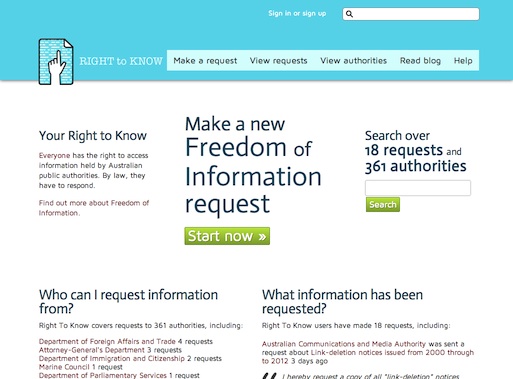
OpenAustralia has now launched a website designed to simplify the FOI process for ordinary people, making it easier for Australians to understand what they request from which government agencies and the process of making and completing these requests, as well as collecting information on the complexities and difficulties of these processes.

The website, Right to Know, is based on a UK model which has been in operation for a number of years and offers both better transparency in the FOI process as well as potentially streamlining the process for government agencies, where they will have to spend less of their valuable FOI officer time on explaining how to make valid FOI requests.

The site will also help capture released documents and collect data on the complexity and issues with FOI processes, helping the government to improve them in the future.

The site is launching at a time when the government is reviewing the operations of the revised FOI Act, and it will also be interesting to see what this review recommends - and what is ultimately done with these recommendations.

I'm hopeful that the government and public service will look on the launch of Right to Know as a positive step that supports the goals of FOI, rather than considering it as yet another impost on their operations, even if long-term FOI stalwards such as Allan Rose believe that the culture change necessary in the public service to support FOI are yet to occur.

2013 Australian government's opportunity to rethink the role of Government CIO

A few weeks ago Ann Steward, the Australian Government Chief Information Officer (CIO) and Deputy Secretary leading AGIMO (the Australian Government Information Management Office) announced she was retiring from the public service after seven years in her current role.

Her announcement was widely covered in the media, and there's been a number of public and, I am sure, private thanks and congratulations to her from her (soon to be) former colleagues across the Australian Public Service, from the present and from former Australian Governments for her work in the service of Australia.

I'm not going to add to this chorus, other than to say that I believe Ann performed admirably, given the opportunities and constraints of her roles and duties.

Instead I want to look forward - to consider how this is an opportunity for the Australian Government.

When Ann took up her role in 2005 as Government CIO, about 67% of Australian households had a computer and only 56% had internet access. The majority accessed the internet via dial-up (67%), with only 28% using broadband (with most broadband 2Mbps or less in speed) (ABS Household use of Information Technology 2004-2005 - PDF).

YouTube and Google Maps were new, both launched in February 2005, while Facebook was over a year away from extending beyond universities to the public (in September 2006). Geocities and MySpace ruled the roost.

Government's online IT efforts were focused on eGovernment - streamlining the speed and cost of services through online forms and reports. Government 2.0 had only just been coined as a term and the use of social media for government engagement was barely on the radar of the most progressive public servants.

The role of Australian Government CIO was defined in the context of these times. AGIMO was focused on providing IT leadership to agencies around egovernment, but had a weak mandate when it came to doing more than advising or suggesting and had no mandate at all for supporting and encouraging other forms of online engagement by agencies.

We now live in a different world. Close to 100% of Australians use the internet for an average of over 48 hours per month online. The overwhelming majority of Australians use broadband (96%) and it is their most popular way of engaging with governments.

Social media rules the roost online, with Social Media News reporting that over 11.5 million Australians are using Facebook, 11 million use YouTube and 3.7 million use Blogspot - each month.

Internationally we've seen many governments introduce strong central mandates for the use of the internet in service provision, public engagement, policy development, accountability and transparency.

The US and UK have introduced strong central government CIO roles, who were not only first amongst equals, but who were mandated and empowered to proactively lead whole-of-government agendas for IT, particularly online.

Australia's government has an opportunity to similarly rethink the role of Government CIO - whether the current role definition, whole-of-government responsibilities, placement (currently in the Department of Finance and Deregulation), funding and objectives.

There is an opportunity for Australia to follow the bold leadership of other nations to mandate a more powerful and central role for the Government CIO than was previously the case. A role that allows the CIO to mandate and enforce standards on agencies, rather than simply providing advise and support which can be ignored.

The main risks that I see right now are that Ann Steward's replacement is appointed as a matter of procedure - selecting the best person for the currently defined role, rather than reconsidering how the role should be defined. This will send a critical message to agencies, the media and the public that the Australian Government is still living in 2005, seeing the internet as a 'nice-to-have' cost-efficiency channel alongside their other one-way engagement channels, rather than as a paradigm shift in how societies interact with each other and with governments.

The second risk is that the role is redefined behind closed doors, not secretly, but through old practices, where a small group of people decide what is appropriate without consultation with the broader engaged community. This would send a message that, while government recognises the challenges brought on by the digitalisation of engagement, it is not yet ready to embrace the opportunities - to bring a larger set of voices into the conversation and pursue more transparent and accountable governance.

I've heard nothing about the process for replacing Ann as yet, and the government and Department are likely still coming to terms with her decision and the ramifications. There's still opportunity to consider taking a different approach to what is becoming an increasingly important central role for spearheading the necessary cultural and IT changes in government to help Australia's government remain fit and competitive for the 21st century.

The process and the new appointment could have a large impact on how Australian Government employs IT and engages online to meet the needs of society, the type of level of impact that could see individual governments rise or fall based on how well they meet community needs.

I hope that the Australian Government takes up this opportunity, providing strategic leadership by reconsidering the role of Government CIO and opening the doors to hear the views of the many engaged stakeholders who have thoughts as to what the role could be and how it could support the government in achieving its broader policy and service delivery goals - all of which now rely on IT and the internet for public engagement, promotion and delivery.

This would send a strong positive message to current and prospective public servants, to the community, industry, the media and to other nations - that Australia is one of the powers to watch in the 21st century.

2013 Is social media blurring the non-partisan status of appointed public servants?

A separation that is widely understood within governments, but often less well understood in the rest of the community, is the separation between politics and public service.

Elected public servants, politicians, ascribe to specific political ideologies and policy positions which form the basis of how people select which politicians and parties to support and cast their votes for.

Unelected public servants, the appointed public service, strive to remain politically unaligned and non-partisan, neutral advisors and implementers of the ideological and political wishes of elected politicians.

This system is designed to balance the instability of democracy with the continuity, stability and certainty of continued governance and public service delivery, allowing appointed public servants to continue on an ongoing basis while elected politicians of various political stripes come and go.

Shifting the balance to largely political - where the majority of the public service is replaced at each change of government - would make governance unstable, with nations unable to rely on the continuity of contracts, laws, support or services they need to conduct their lives and businesses.

Whereas shifting the balance to largely apolitical - where elections are rare or of figurehead positions only - would remove the democratic option for nations to change their minds as to how they prefer to be governed, effectively dictatorships in all but name.

Therefore preserving the separation between politicians and public servants is a primary consideration of Australia's system of governance - as it is in most democratic states - while a delicate balance needs to be maintained where public services willingly and proactively carry out the will of the elected (political) government, however unelected career public servants retain the independence to provide frank and fearless non-partisan advice in their professional lives and the ability to participate as full citizens (with their own political views) in their private lives.

Australia has legislation, codes and policies to maintain this separation, which have largely worked well over the last century, although I - and most current or former public servants - have seen cases where the lines can get quite blurry between serving the government of the day and 'signing on' to the government's political position and cases where individuals have let their personal views overwhelm their professional need to remain non-partisan.

Social media is adding complexity to this mix, providing channels for government agencies and appointed public servants to have a louder and more direct public voice whereas previously government communications was limited to traditional media channels - radio, television and newsprint - where comments could be tightly filtered through communications teams, media specialists and Ministerial offices.

Today's media landscape allows every government agency and appointed public servant to be a participant, informer or influencer, in public debate. They can establish their own communications channels at little or no cost and distribute messages with, potentially, little or no central oversight (or as many approval processes as they like, but at the cost of speed and relevancy).

While for the most part agencies and public servants have been guarded and cautious in the use of these new channels - ensuring they have sound guidance and principles in place to preserve their non-partisan position - a few channels have become more blurry, presented as government channels but presenting political views.

These channels - and their proliferation as precedents are established - could easily confuse the lines between partisan and non-partisan, politicians and the professional appointed public service. This risks politicising the public service, confusing the public and damaging democracy.

Let me offer a few examples.

Firstly, in the Australian Government's list of official government social media accounts, Australia.gov.au (managed and administered by AGIMO in the Department of Finance and Administration) lists the Twitter account of Julia Gillard (@JuliaGillard), Australia's Prime Minister, alongside the accounts of departments, agencies and government programs.

Unlike all of the other accounts listed by Australia.gov.au, Julia Gillard's account is operated by a politician (Julia Gillard herself) and her Ministerial staff - who are largely political appointments with strong links to the Australian Labor Party.

While Julia Gillard fills an official government role, that of Prime Minister, she is a politician, elected to this public office by her party, who happens to hold enough votes in the House of Representatives to be able to form government.

While her Twitter account (@JuliaGillard) does include apolitical tweets about the Australian Government, it is also used for her personal and party political purposes and cannot be considered apolitical or part of the professional and apolitical machinery of government.

Her account regularly tweets messages that slip into politically partisan territory, such as:
"As a government of purpose and strong policy commitments, we won’t be distracted by their weakness and negativity."
Source: https://twitter.com/JuliaGillard/status/275385120863703040

5 years of Labor. A lot done, a lot left to do. TeamJG
Source: https://twitter.com/JuliaGillard/status/272165948952285184

RT @AustralianLabor: Greg Combet today gave a great run down of how the is going and the Spring Racing form of the Liberals: 
Source: (Original tweet) https://twitter.com/AustralianLabor/status/263893246667812864

It is perfectly legitimate for our Prime Minister to have this account and to use it as she sees fit. However, on the basis of tweets such as those above, her account shouldn't be included in a list of official government Twitter accounts where it could be confused as the standard approach for all government departments and create a perception that the Australian Public Service is partisan towards the Labor party, rather than a non-partisan body that advises and implements the Australian Government's (who happens to be the Labor party) dictates.


A second example is from QLD, the @QLDStateBudget twitter account, owned and managed by the QLD Department of Treasury and Trade (see it linked from the bottom right of their page).

This account, which has provided good news and updates regarding the QLD government budget in a largely non-partisan way, has also (disconcertedly), published tweets like:
TOUGH CUTS: Wayne Swan should take a leaf out of Campbell Newman's book: 
Source: https://twitter.com/QldStateBudget/status/246439391512371200

Which is a very political tweet indeed.

This account, as a purported departmental account, shouldn't stray into this type of political commentary and is clearly being influenced by a Ministerial office.

While this Twitter account hasn't been tweeted from for over 80 days, and may no longer be active, the tweets remain public and therefore the perception remains plausible.

Perception is reality
In both examples above the lines between elected and appointed public servants are blurred - which can create confusion and a perception that Australia's professional public service is no longer operating in a non-partisan and independent fashion.

While I don't believe this is the case, as for many things in government perceptions are reality. In a situation where the public and the media are often already confused about the separation between elected and appointed public servants, it is critical for agencies and governments to ensure that the separation remains distinct and clear in perception, as well as reality.

If social media makes this harder, due to the ease of posting publicly and the difficulty in removing material from the public domain, then it becomes even more necessary for senior public servants and politicians to understand social mediums, be aware of the risks, sponsor the creation of appropriate guidance and training for their staff and apply appropriate discretion at all times to minimise and resist any tendency to blur the lines.

Solving the problems of cities via crowdsourcing - LLGA Cities pilot the future program

As cities are become more complex, so are their strategic challenges and the need to find innovative solutions to best serve their citizens.

With governments tightening their budgets at the same time, the challenges of modern cities are beginning to slip beyond the ability of city councils, or even national governments, to solve alone.

As a result many are now looking beyond their bureaucrats for support and solutions, using crowd sourcing to drive innovation and broaden their policy and service options.

A key example of this is the LLGA's Cities Pilot the Future program, now entering its fourth year.

The premise is simple. Cities publish details of a strategic challenge they need help solving and the public, social enterprises, research centres, not-for-profit and for-profit organisations are invited to contribute their solutions. Jurors shortlist and select winning solutions, which are then implemented.

Over the past three years 42 global cities from Europe, North, Central and South America, Africa and Asia have taken part in the annual programs - in fact the only populated continent not to have taken part in the program is Australia.

The last three programs received in more than 1,197 entries, leading to over 30 pilot programs, affecting 285 million citizens across 38 cities.

The 2013 program, which opened last week for entries, features an enormous range of different strategic challenges from 21 cities including:

  • Aalborg, Denmark: Traffic congestion early-warning system
  • Barcelona, Spain: Regenerate neighbourhoods using vacant space
  • Boston, USA: Rethinking road castings
  • Christchurch, NZ: Transformational lighting system
  • Eindhoven, The Netherlands: Data exchange on public facilities and activities
  • Fukuka, Japan: Smart international conference destination
  • Lagos, Nigeria: Networked standalone content hotspots
  • Lavasa, India: Social uplift and empowerment
  • London, UK: Energy and greenhouse gas measurement
  • Mexico City, Mexico: Digital tools for better, healthier ageing
  • Oulu, Finland: Encourage visitor engagement through technology
  • Paris, France: Making outside seating more resilient
  • Rio De Janeiro, Brazil: Accessible healthcare in intelligent cities
  • Rosario, Argentina: Network of green homes
  • San Francisco, USA: Storm response coordination tool
  • Sant Cugat, Spain: Smart Cityscape - maximising existing resources
  • Sheffield, UK: Capturing and distributing industrial heat
  • Tacoma, USA: Sustainable return on investment tool
  • Terrassa, Spain: Connecting people to progress
  • York, UK: Reducing health inequality in York

I think the list above, together with the diverse range of strategic issues cities identified in past years, demonstrates the potential range of challenges that crowdsourcing can be used to help cities solve.

Given the global range of participating cities in the LLGA program, my question is - where are the Aussies? 

Is it that our governments have single-handedly solved every strategic challenge in our cities?
(I don't believe this is true)

Or is it that Australian governments are dropping behind the rest of the world in adopting innovative approaches to solving challenges - afraid of involving citizens more broadly in finding solutions?
(I hope this isn't true!)

Wednesday, September 19, 2012

Is Parliament House the peoples' house? Beth Noveck: Demand a more open-source government

Is Parliament House the peoples' house or the government's house?

This is one of the fundamental considerations within the open government movement. Does government exist to serve the public? Who participates in developing policy, creating laws and deciding what is best for citizens and communities?

Beth Noveck, in her TED Global presentation, Demand a more open-source government, poses a number of challenges to citizens and governments around the world to open up governance processes, involving citizens at every stage.

Brought to my attention by Andrew Krzmarzick of Govloop, Beth Noveck Delivers Terrific TED Talk on Open Government, Noveck's talk is the best I've seen on the topic this year.

There's also a great blog post about the presentation at the TED site, Demand a more open-source government: Beth Noveck at TEDGlobal 2012

I strongly recommend that you watch Noveck's talk and share it widely with your colleagues.


Monday, September 17, 2012

Mapping open data site generations

Over the last three years we've seen an increasing level of sophistication and capabilities in successive generations of open data sites.

To aid governments in their open data journey, I've mapped five generations for the progressive development of open data sites, detailed in the document below.

Please feel free to reuse the information within the bounds of the embedded Creative Commons license.

My next task is to release a view of open data sites around the world mapped against these generations to provide a view as to who is leading and who is lagging in the open data stakes.

Friday, September 14, 2012

Can foreign digital gatekeepers unduly influence democracy?

One of the perils of the digital age, as traditional media goes digital or goes downhill and more and more people rely on the internet for their daily news, is that countries such as Australia are losing 'editorial' control over what news is promoted as the 'top stories' each day or what links appear at the top of search results.

Most of Australia's most trafficked websites are not Australian-owned and run. Some do not even have a legal entity or physical presence in the country, making it extremely difficult for Australian interests to get any kind of traction in decision-making processes or ensure that Australian values and perspectives are reflected.

Even more worrying, we've already begun to see digital 'gatekeepers' - the largest and most influential websites - begin to impose conditions which may distort elections or inappropriately influence democratic processes.

Let me give you an example. You're probably aware that Google is the most trafficked website in Australia, followed by Facebook. In fact for the week of 8 September 2012, Experian Hitwise reported that Google Australia received 149.5 million visits from Australians, and Facebook received 96.8 million visits. These were followed by Youtube at 47 million, Windows Live Mail at 23 million and Google.com which received 21.7 million Australian visits.

The top locally operated website, NineMSN received only 20 million visits. Yahoo7 received only 11 million visits from Australians.

In fact, if you add Google's top 10 sites (218.2 million visits) and Facebook, the total visits these two organisations receive from Australians, each week, is about 315 million. That's ten times the combined weekly traffic of NineMSN and Yahoo7 at 31 million.

With that level of traffic, being refused the right to advertise in Google or Facebook could have serious repercussions for a brand. In some cases it could destroy companies.

So what could it do to democracy?

What would happen if Google and/or Facebook decided, for whatever reason, to reject all the advertising from a particular political party in Australia, banning ads for that party in their sites during an election?


Well, actually, we don't need to speculate about this scenario. It's already happened.

Some of you might be aware that during the last Commonwealth election that Google refused to run any advertising for one of Australia's legal political parties - the Sex Party.

Following this, Google again refused to run any Sex Party ads during the recent Victorian byelection.

Facebook joined in by rejecting Sex Party ads during the recent Sydney City Council election.

Now whether you support or oppose the Sex Party's views, they are a legitimate Australian political party and field legitimate candidates in elections. However both Facebook and Google decided, citing different reasons, that they would not accept any advertising from the Sex Party during election campaigns.

Facebook said its reason was that the Sex Party was "promoting adult products or services".

Google claimed that the Sex Party was being deceptive by having a "donate" button on its site which "breached its rules which prevent solicitation of donations by a website that did not display tax exempt status.". 

When it was pointed out that the Greens, Family First and Labor all did the same thing, Google stuck to their guns. Even when the Sex Party adjusted their site's content to include the tax exempt status, Google continued to refuse to run ads - contrary to their own policies. Only when the Sex Party went to the media did Google relent, on the eve of the election when the opportunity to influence votes had been lost.

In this case the party was a minor one and potentially the events didn't change the outcome, although the Sex Party has taken Google to court over the matter alleging unlawful interference in the election.

This example highlight a risk democracy is facing. 

When 'media' providers control such a large chunk of the online market, when these are domiciled overseas in state that wish to influence Australian politics, and when they can thumb their noses at local concerns without significant legal or financial cost, democracy has a problem.

It doesn't have to be a full-out blocking of ads or comments - as happened in the example above. Instead it could be more subtle techniques. 

Such as placing ads lower down on the page than their competing parties, thereby reducing the probability of a click, it could involve adjusting search results to keep certain ideas at the top, or the bottom. It could even involve 'reporting errors' which would convince people that they'd received the impressions they'd paid for when they hadn't.

There's many other subtle ways to influence behaviour online, and you can be assured that companies like Google and Facebook have built a strong understanding of how to do this. It is their bread and butter and they are testing, trialling and learning more all the time.

So can digital gatekeepers unduly influence the outcomes of democracy processes? 

I think yes. And, intentionally or not, the big players have already demonstrated that they are capable of taking this step. 

But maybe not quite yet, while nations still have robust national media and competing theatres for ideas.

In the future we are likely to see the balance of power unfold in new ways, and learn through practice whether democracy will survive technology intact, enhanced or destroyed.

However it is already clear that democracy will not survive unchanged.

Wednesday, May 16, 2012

Can social media make a genuine impact on the democratic process?


While in the UK last week I was involved in a number of discussions about whether social media can make a genuine impact on the democratic process.

This reflects similar conversations I've witnessed or been involved with in Australia and in other countries.

This conversation is very important - it helps people involved in the Gov 2.0 space to define, refine and share their ideas and helps people outside the space gain a broader appreciation of the topic.

To encourage further conversation, Delib has set up a global online discussion about social media's impact on democracy.

You can participate - or watch this discussion at: http://www.dialogue-app.com/600


It will remain open for commenting until the end of May and visible after this for people to read and think about.


Wednesday, May 9, 2012

eDemocracy report from Lowey - US striding ahead

If I were the leader of a nation that wasn't friends with the US I would be very concerned with the successes of their eDiplomacy program and looking to counter it with my own.

And if I was the leader of a friendly nation, I'd still be seeking to carve out my own eDiplomacy space, to retain some element of influence in the future.

The UK has realised this, Canada has realised it, though I'm not as sure Australia has woken up to it as well.

The Lowey Institute has released an excellent report on the state of US eDiplomacy by Fergus Hanson, which may help as a wake up call.

Brought to my attention by Peter Timmin, who writes the Open and Shut FOI blog, Fergus's report, the result of four months spent in the US with the State Department, found that there are now 25 separate ediplomacy nodes operating at State’s Washington DC Headquarters employing over 150 full-time equivalent staff.

Additionally (the report says) a recent internal study of US missions abroad found 935 overseas staff employing ediplomacy communications tools to some degree, or the equivalent of 175 full-time
personnel.


The report states very clearly that, in some areas ediplomacy is changing the way State does business. For example,
In Public Diplomacy, State now operates what is effectively a global media empire, reaching a larger direct audience than the paid circulation of the ten largest US dailies and employing an army of diplomat-journalists to feed its 600-plus platforms.
In other areas, like Knowledge Management, ediplomacy is finding solutions to problems that have plagued foreign ministries for centuries.
One of the key changes that Fergus noted was how the organisation functioned as a start-up, not as a staid old-fashioned bureaucracy. For example,
In interviews with office staff, conversation quickly turns from notional duties to ‘passion projects’ – the new ideas and platforms staff work on in their spare time. And there are plenty in the works. The Inspector General, whose recent report on the office made it sound like a review of a Silicon Valley start-up, noted over 40 underway.
Other employees also seem to have got a message regularly repeated at the Office of eDiplomacy; Experiment. It’s okay to fail. One enterprising official working on US library spaces abroad realised how costly and pointless it was sending physical books across the globe and cut a deal with Amazon to get discounted Kindles delivered instead.
And in Zimbabwe, the greying US Ambassador, Charles A Ray, has embraced Facebook as a way of circumventing the iron grip Robert Mugabe exercises over freedom of the press. He engages in an active and animated discussion with Zimbabweans about how they view the world.
In my view this report doesn't only highlight the new world of diplomacy, but also the new world of the public service.

The approach taken to engage foreign citizens could be transferred to domestic agencies and used to engage US citizens as well.

Is State the future of public services around the world? Time - and good leadership will tell.

However just as nations who fail to remain commercially competitive find it increasingly difficult to maintain incomes, education levels, lifestyles and services, countries that fail to be competitive in their public governance are likely to be at significant disadvantage in international relations.

eDiplomacy is already here and working. The challenge has been laid down. Can Australia's present public sector and political leaders take it up?

Sunday, April 29, 2012

Two year review - has the Australian Government delivered on its Government 2.0 commitments?

It has been almost exactly two years since the Australian Government responded to the Government 2.0 Taskforce report on 3rd May 2010.

The response, which committed to implement most of the recommendations in the report, was made under Prime Minister Kevin Rudd and with the support of former Finance Minister Lindsay Tanner (neither of whom hold a position in the current Australian Government).

So how has it gone? Has the government, through a change in leadership, an election and the retirement of the responsible Minister, implemented most of the recommendations or not?

Below is a summary of what they agreed to implement and, in my view, what has been achieved in the last two years. Under this is my conclusion, and a more detailed analysis of each recommendation.


RecommendationStatus
Central Recommendation: A declaration of open government by the Australian Government Implemented
Recommendation 2: Coordinate with leadership, guidance and support Implemented within the Government's agreed commitments
Recommendation 3: Improve guidance and require agencies to engage online Implemented within the Government's agreed commitments
Recommendation 4: Encourage public servants to engage online Implemented within the Government's agreed commitments
Recommendation 5: AwardsImplemented
Recommendation 6: Make public sector information open, accessible and reusable Largely implemented, although it is unclear if agencies have "been required to ensure that public sector information which is released is also made available through [data.gov.au]"
Recommendation 7: Addressing issues in the operation of copyright Implemented, however I am unsure whether the review of orphaned copyright works has taken place
Recommendation 8: Information publication scheme Allocated to the Office of the Australian Information Commissioner to implement, whose office is operating at 75% staffing and faces budget cuts through the increased efficiency dividend
Recommendation 9: Accessibility Nothing to implement directly - however the Government has done exceptionally well in outlining and enforcing the Web Accessibility National Transition Strategy
Recommendation 10: Security and Web 2.0 Nothing to implement directly
Recommendation 11: Privacy and confidentiality Nothing to implement
Recommendation 12: Definition of Commonwealth Record Implemented
Recommendation 13: Encourage info-philanthropy Nothing to implement and no activity based on either the review or the report has significantly affected the info-philanthropy area

In conclusion

In my view the Australian Government has implemented and completed the vast majority of the commitments they agreed to following the Government 2.0 Taskforce.

There are a few areas where commitments were not actually made (although some might have liked them to be), a few where meeting the agreed commitment might have been done in practice, but not in spirit and a few where changing circumstances have changed how commitments were implemented.

Now the challenge for the Australian Government, and the Australian Public Service, is to move beyond the Government 2.0 report and agreed commitments. To define the next level for Gov 2.0 in Australia, and  consider how to build it.


Central Recommendation: A declaration of open government by the Australian Government

The Australian Government committed to making a declaration, which was met by Minister Lindsay Tanner shortly before he left office and is available at Finance's website at: http://www.finance.gov.au/e-government/strategy-and-governance/gov2/declaration-of-open-government.html


STATUS: Implemented.


Recommendation 2: Coordinate with leadership, guidance and support

The Australian Government committed to establishing a lead agency to lead a cross-government steering committee for Government 2.0.


The Government selected the Department of Finance as the lead agency (the recommendation did not specify which agency), and Finance formed a steering group involving senior representatives from a range of agencies.


The Steering Group moved to quarterly meetings (four times a year) in 2011. The last update I am aware of from the Steering Group was published in June 2011.


STATUS: Implemented within the Government's agreed commitments.


Recommendation 3: Improve guidance and require agencies to engage online

This involved improving guidance, which the Australian Government agreed to deliver via the Australian Public Service Commission (APSC), resulted in three circulars regarding online engagement, with this guidance now embedded in the APS Code of Conduct in Practice as the 'Contributing online' section.


The Australian Government also agreed it was important for agencies to embed Gov 2.0 practices in their everyday business activities in order to progress cultural change, although the only real activity promised was to have the Steering Group oversee activity and operate a Gov 2.0 blog for twelve months (which has been delivered via http://agimo.govspace.gov.au)


The Government also committed to incorporating an Open Government progress report in the State of the Service for 2010-2011 (but did not commit on an ongoing basis) and agreed in principle to more transparency in public inquiries - which was to be delivered through having the Steering Group develop a policy "to encourage best practice in this area that simultaneously protects information that ought not to be disclosed."


STATUS: Implemented within the Government's agreed commitments.


Recommendation 4: Encourage public servants to engage online

The Government agreed to implement this through the revisions to APSC guidance (as per Recommendation 3) and by developing guidance on Government 2.0 engagement by agencies, delivered through AGIMO's Government 2.0 Primer.


The Government also stated, without committing to any action, that,
It is incumbent on the senior APS leadership to ensure that top-down change is enabled in agencies, and that APS employees are genuinely encouraged and empowered to engage online within their agency-specific context.
The cost of agency change required to address internal technical and policy barriers will be the responsibility of agencies to absorb as part of their business-as-usual activities."
and that,
Australian Government agencies should therefore enable a culture that gives their staff opportunity to experiment and develop new opportunities for online engagement. 
Agencies may wish to develop internal incentive mechanisms – in addition to the Government 2.0 awards proposed at recommendation 5 of the Report – to encourage employee innovation and online engagement. 
Agencies should also ensure that a broad range of stakeholder groups are considered for engagement online, for example, a health practitioner’s blog providing feedback on Medicare procedures, in addition to citizen’s blog on proposed improvements to the claims’ process.
Finally, under this recommendation the Government committed to showcasing best practice through an online forum - which has been achieved via the Gov 2.0 Register and the Innovation showcase.


STATUS: Implemented within the Government's agreed commitments.


Recommendation 5: Awards

The Australian Government, through the Department of Finance, agreed to include Government 2.0 awards for individuals and organisations within the existing Excellence in eGovernment Awards.


STATUS: Implemented.


Recommendation 6: Make public sector information open, accessible and reusable

This contained quite a complex recommendation.


The Government agreed in principle, based on the existing reform of Freedom of Information laws and the appointment of the Information Commissioner.


The Australian Government did commit to revisions of copyright policy to make the default copyright position for Commonwealth agencies Creative Commons By Attribution (CC BY).


The Government also committed to establishing the data.gov.au website, "to facilitate access to public sector information. Agencies will be required to ensure that public sector information which is released is also made available through this central portal. Information which is posted on data.gov.au should contain details of the nature, format and release of the information."


STATUS: Largely implemented, although it is unclear if agencies have "been required to ensure that public sector information which is released is also made available through [data.gov.au]".


Recommendation 7: Addressing issues in the operation of copyright

The Government agreed to implement a change in copyright (as in Recommendation 6), but not to move the administration of copyright to the new Office of the Australian Information Commissioner (OAIC), leaving it with the Attorney-General's Department (AGD).


The Government also agreed to a review of orphaned copyright works, though again left this with AGD, rather than transferring responsibility to the OAIC.


STATUS: Implemented, however I am unsure whether the review of orphaned copyright works has taken place.


Recommendation 8: Information publication scheme

This recommendation was accepted by the Government, with the Information Commissioner tasked with taking all the issues outlined within it into account.


STATUS: Allocated to the Office of the Australian Information Commissioner to implement, whose office is operating at 75% staffing and faces budget cuts through the increased efficiency dividend.


Recommendation 9: Accessibility

The Australian Government agreed with the recommendation, however only committed to improving accessibility, without defining what 'improvement' means.


The response did not outline any other specific activities or commitment, but reaffirmed that the Government had set WCAG 2.0 compliance as its standard for accessibility and that accessibility would be considered as a criterion in the Excellence in eGovernment Awards.


STATUS: Nothing to implement directly - however the Government has done exceptionally well in outlining and enforcing the Web Accessibility National Transition Strategy.


Recommendation 10: Security and Web 2.0

This recommendation stated that the lead agency, in co-operation with the Defense Signals Directorate, develop a better practice or 'how to' guide "to assist agencies in the effective, efficient and secure use of Web 2.0 tools and how to undertake associated risk assessment."


It also stated that,
"DSD should provide guidance to agencies on the appropriate mitigation treatments that could be adopted to address concerns or exposures identified in relation to the use of social networking and related tools. This guidance should take into consideration the different environments in which agencies operate, the varying risk profiles that exist and the range of tools that may be used. DSD should update the Information Security Manual (ISM) accordingly."
And,
"the proposed OIC should provide advice to agencies in relation to the treatment of PSI to enable its broadest possible release. Consistent with good practice, and the requirements of the Protective Security Manual (PSM), agencies must avoid the over classification of data so as to limit the need to review or pre-process data to enable its release."
The Government didn't commit to any specific actions, though it did state that,
"The Australian Government believes that public sector information is a national asset and is committed to working to find the best ways for both government and citizens to utilise its value. Within this frame, it is important that agencies are supported in implementing this measure this by better practice guides and appropriate mitigation treatment options. 
The Information Commissioner will take account of recommendation 10.3 when issuing guidelines under the FOI legislation."
STATUS: Nothing to implement directly.


Recommendation 11: Privacy and confidentiality

This recommendation stated that,
11.1 To protect the personal information of individuals included in PSI, the Privacy Commissioner should develop guidance on the de-identification of PSI before it is released. 
11.2 To protect the commercial-in-confidence information of businesses included in PSI, the proposed OIC should develop guidance on the de-identification of PSI.
The Government's response was that this was already in operation,
either by protection of the personal information or by relevant exemptions under the Freedom of Information Act 1982.
And that,
The Information Publication Scheme will provide the legislative framework for information held by government to be published, subject to the exemptions consistent with the FOI legislation. 
STATUS: Nothing to implement.


Recommendation 12: Definition of Commonwealth Record

The recommendation focused on providing clear guidance on what, in the Gov 2.0 world, constituted a record and how they should be archived.


The Australian Government committed to having the National Archives of Australia (NAA) provide guidance for agencies on "what constitutes a Commonwealth record for the purposes of actions undertaken in the Web 2.0 context."


The NAAhas provided guidance through several articles, including Your social media policy – what about records? and Social media: Another type of Commonwealth record.

The Government also committed Finance and the NAA to provide guidance on endorsed metadata standards, which has been delivered via the WebGuide.


STATUS: Implemented.


Recommendation 13: Encourage info-philanthropy

This recommendation was deferred, to be "considered in the context of the Australia’s Future Tax System Review and the Productivity Commission’s report into the contribution of the not for profit sector."


For more about these, see:
STATUS: Nothing to implement and no activity based on either the review or the report has significantly affected the info-philanthropy area.